Ukraine 2025
From August to October, I volunteered in Ukraine, in Chernihiv Oblast, specifically in the village of Anysiv, building homes with the charity Repair Together. Additionally, I was able to spend some time in the city of Chernihiv and Kyiv.


1)


2)


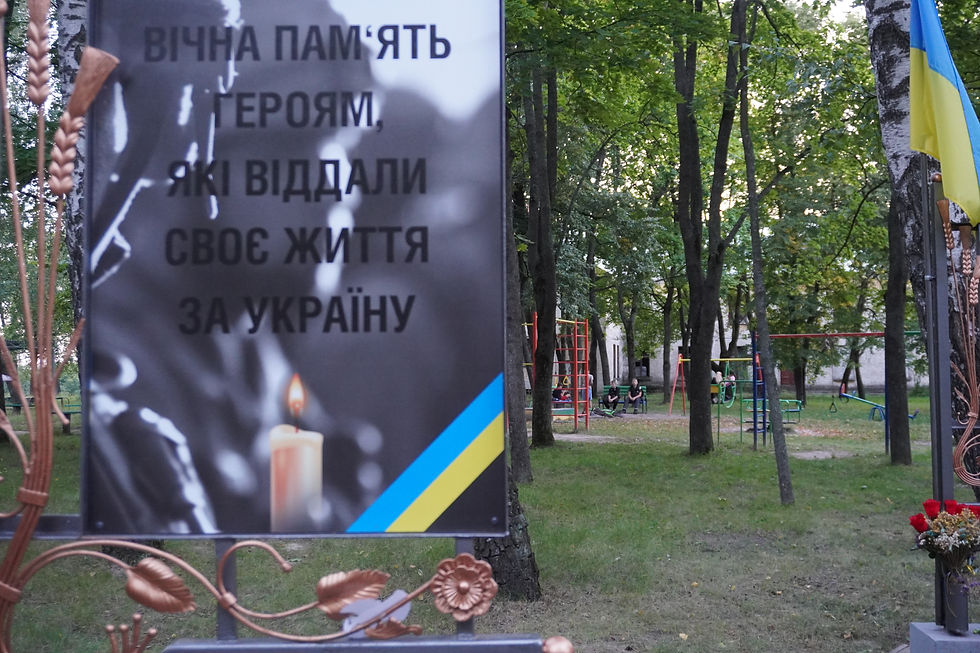
During the Siege of Chernihiv, Russians had attempted to surround the city. Taking the city was strategically important to the Russians as the road, also known as the 'road of life', led directly to to Kyiv. Taking such an advantage could have proved disastrous in the battle of Kyiv, something western media said would be over in 3 days with a Russian victory. Fortunately the offensive was stopped at the village of Anysiv but this meant a barrage of bombing to weaken Ukrainian forces. You'll notice the photos above contain damaged buildings, shrapnel remnants, and lost lives. One soldier being only 24.
Yet, its easy to forget this war did not start in 2022 but 8 years in earlier in 2014 with the war in the Donbas and annexation of Crimea. Ukrainians I talked to always referred to 2022 as the full scale invasion, hinting at this is when Russians openly declared war. 2014 seemed to be more covert, with Russia sending the little green men and funding Russian backed separatists. There seems to be a level of separation; younger Ukrainian don't register it as a important event while older Ukrainian I spoke to have referred to it similarly to the troubles in Northern Ireland. However, the terminology of full scale invasion and its continual mention in this way rather then just 'the war' allows us to fully contextualize the history. In photo 1 you'll see the faces of soldiers who have died, yet the dates are all pre-2022. This war has not just started contrary to what westerner believe. Furthermore, the preferences of using terms like de-occupied rather then liberated have become essential in shaping the narrative. De-occupation is said to sound more legalistic while liberated can sounds more charged and emotional. In war with competing ideologies framing such events is imperative.
Walking around the cities while war remains prevalent is a bizarre feeling. Adverts supporting a specific battalions are everywhere. Most obvious one is the Azov battalion, a controversial unit with debatable ties to Neo-Nazi groups. The Ukrainian government has stated that this group has been de-politicized. While I don't want to feed into Russian propaganda, which states that its there to de-nazify the country, I did see subtle support from some individuals, mostly from the younger generation. I saw people wearing swastikas with shaved heads like it was fashion trend. Additionally in photo 2 you can see Stepan Bandera, a Ukrainian far right figure who fought along side the Nazis against the red army in WWII. Given the history of Babi Yar, the massacre of 100,000 Ukrainian Jews, the rectification of political figures like Bandera and the Swastika seem more of an anthesis to Russian/Soviet imperialism rather then outright support of Nazi ideology. Zelensky being a Jew and getting 75% of the vote in 2019 does support this hypothesis. Either way it was surprise.
Apart from this, life in Kyiv is relatively normal. Apart from the drones, the sirens, and the curfew you could forget that the country is at war. Young people are out and businesses are thriving. The sirens seem to have no effect; people continue their day like its an annoying occurrence. Watching the news from back home may seem like people are fearful but hope is stingingly abundant and resistance remains on everyone's mind. Ukrainians remain united


3
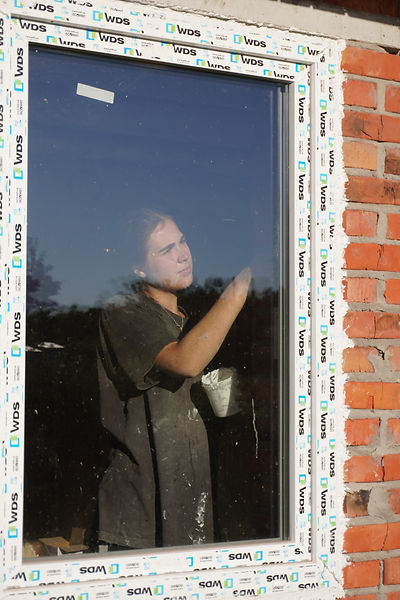


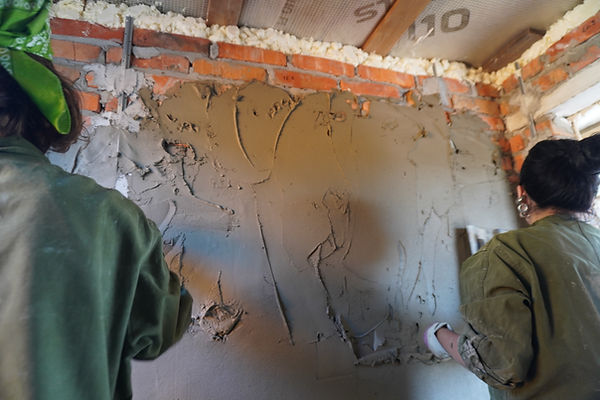


The charity Repair Together had a total of 20 members when I arrived, but this varied from around 10 to 30. The camp members nationalities comprised mostly of Europeans, but there were some Americans and a Japanese girl. Yet Ukrainians made up the majority of the numbers unsurprisingly. No matter where they were from all were united around a single cause. Some like Jesse, in photo 3, were joining the actual Ukrainian army after his time at the camp. I spoke to him at length about his reasoning and decision to fight for a country he had never been to before. This made me question my own level of support and whether it was a duty to stand against Putin. Jesse, like many others, have taken the ultimate risk in the defense of democracy, freedom, and self-determination. These values aren't self evident or just given. They are fought for.
Hearing a drone for the first time is distinct. The sound is a monstrously loud humming which confuses your senses as the noise alludes to something much closer. Even in the day they are hard to see. The whirring is followed by the crack of anti aircraft guns. One day after a pleasant lunch at a locals house, an explosion went off. Ballistic missiles are also a daily occurrence. We had later learnt that the missile had hit an international humanitarian organization called the Danish Refugee Council with 2 people killed and 8 others injured. For the first since arriving I had to question my own safety and whether this was a clear sign for me to leave.
Conversations in the camp varied but the topic of language was always interesting. Ukraine is a bilingual nation speaking both Russian and Ukrainian. Yet, speaking Russian does mean your siding with Russia. The Zelensky Effect by Dr Olga Onuch, a Ukrainian politics professor at the University of Manchester, wrote a convincing argument about the Ukrainian identity being tied to civic values rather then language or ethnicity. At the camp I saw a different reality. Russian was barred from being spoken at any time. Conversations I had, mostly among people in their 20s, were always about eradicating the language out of their personal lexicon. One person told me that he once called the manager on a waiter who was speaking Russian to get them fired, a seemingly gaity and excessive use of just trivial mistake. Although when your right to exist is being challenged and exterminated, perhaps language is still as important to create cultural cohesion.


To sum up, the photo above are a collection of various things painted the same colours as the national flag. Everywhere from homes to adverts were blue and yellow to symbolise the unity of the country. A reminder that these things are Ukrainian and worth fighting for, for all can be lost and taken if there is a apathetic attitude. In my last days in Chernihiv I was able to speak to a nun of the Piatnytska Church. A medieval church that provided shelter to children during the siege. The conversation was weighty and it was obvious that she was on point of tears. One of last things she said was we just need more guns. Hearing this really solidified my own view. If a devout Christian can preach about the need for more arms, then my reservation about peace and land succession have been misguided. She made me fully comprehend that this is a total injustice. Trump can try to bully Zelensky into making a deal and eventually he may have to do so, but this does take away that innocent people have had to live through war and death. What happens here will not be forgotten.