Chornobyl 2025
In September, I was fortunate enough to be granted special permission to enter the exclusion zones of Chornobyl and Pripyat. Tourists are currently barred from entering, which made this trip extremely rare.


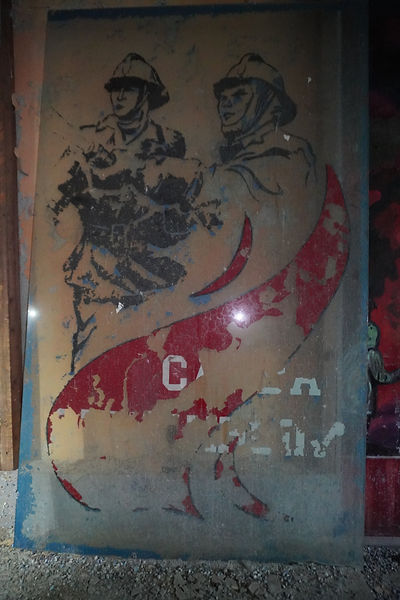
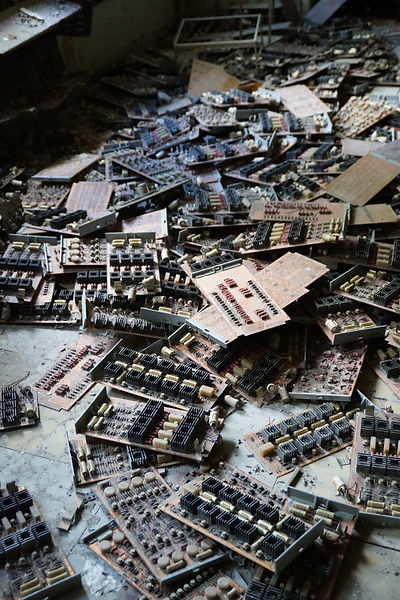


Inside a community centre, a faded inscription reads: “Long Live Communism — the master of humanity.” What’s striking is that it’s written in Ukrainian rather than Russian. Anyone familiar with Soviet history knows that while the Soviets aspired to build a society based on equality, they simultaneously imposed the Russian language on other ethnic groups. Seeing this slogan in Ukrainian is therefore unexpected. It suggests that the enforcement of Russian linguistic dominance may not have been as absolute. Today, however, the ongoing war has taken on a darker irony: Russians are killing Ukrainians precisely for the language and identity they once sought to suppress.
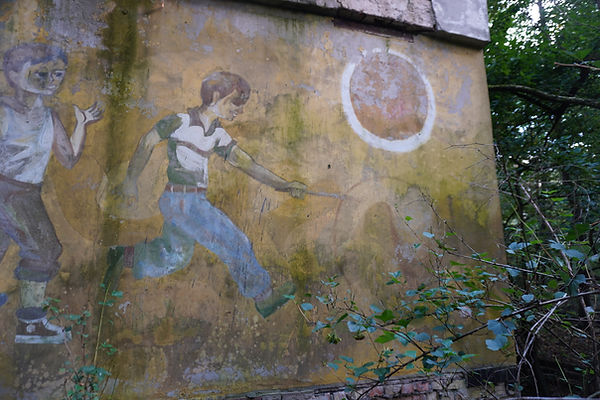


A steel casing covers the nuclear reactor. In February 2025 Russians sent a drone to hit this building


Being able to enter Chornobyl in 2025 in the midst of war feels like truly entering a nuclear wasteland. What used be a popular tourist destination for historians and photographers has now become a militarized area, guarded by Ukrainian soldiers round the clock. Getting in was only possible through certain connections to someone who worked at the hospital. Doctors, Nurses and Dentist are having to do their bit by living at the hospital and switching every 2 weeks. Checkpoints are regular and soldiers were everywhere.
Chornobyl is situated only 16km from Belarus, an aiding ally of Russia. While not committing troops themselves, they have allowed for Russian military to station themselves within the country. At the start of the war Russian troops attacked from Belarus into Chornobly, attempting to take the strategic location to help with taking Kyiv. Alarm bells will be ringing. Though now safe, Chornobyl nuclear site needs continual maintenance and upkeep to prevent a meltdown and radiation leaking. In the middle of a war this could have proved highly dangerous and the probability of disaster would grew exponentially. Only one month later would the offensive be pushed back and Russian troops withdrew from the area. This was 3 years ago but still this place is now entering a new phase in its history.
Some of the first photos I took were of a old bus turned gift shop for visitors. Now the bus is completely shot up. Either this is from a gun fight or some indiscriminate shooting by some Russians. One possible theory is that the bus having the name Chornobyl, the Ukrainian spelling, rather then Chernobyl the Russian spelling is why it was shot.
Next we were introduced to a complex structure 700 meter long and 150 meters high. A soviet era radar system named Duga used in the cold war to detect nuclear war heads. Our guide reminds of the potential uses if such a thing if it was still operational. Walking around your reminded of the cold war era and though this is before my time, it certainty wasn't for my parents. But while the liberal international order may have won with the collapse of the Soviet Union, a new ideological battle is waging between liberalism and authoritarianism. Nuclear weapons are more prevalent then they have ever been and the threat remains very real.
We walk further towards gyms, school, apartments. We see an abandoned piano shop like something out of a poem. This really was the day the music died. Our guide had been here multiple times. He isn't doing this for self gain, he simply ask for us to make a donation to the army. He tells us how it was before the war. Apparently roads would be packed with tourist bustling to get the right photo. One can only imagine the difference in experience that would be. While back then the chatter of various accents and languages would fill the lost space, now a barrage of missiles can be heard consecutively hitting its target like clock work.


Going through an old shop we were told that it was a tradition to leave your local currency in this now radioactive cash register. Our guide tells that it had previously been filled to the brim with various notes and coinage, a sort of wishing well of Chornobyl. Now, in almost a smirking tone, he tells us that the Russians stole everything. It no surprise. Looting has been key factor in the Russian invasion. In the Chornobyl region alone 98 computers, 344 cars, and 1500 dosimeters were stolen, as well as almost all fire fighting equipment needed to fight forest fires.
Overall my experience of Chornobyl was far from what I ever expected. Being a History graduate this place was always on my list to go to and now being here it was if I was shown somewhere completely different. War has transformed this place more then I had ever expected. Its permeated everything and changed the very nature of Chornobyl's history; something that is still currently being written. This is just the essence of war though. To ignore it is to have utopian googles on. Its destructiveness creates such rapid change that what was once known can be completely different. For Chornobyl its now entered a new stage in its history, that being in the middle of war.